Automotive Bearing Glossary for Parts Staff: Wholesale Supplier
Slang terms describe shapes, not specifications. Relying on workshop nicknames instead of technical codes is the fastest route to ordering errors and financial loss in the automotive aftermarket.
Mastering automotive bearing terminology, part numbers, and suffixes prevents costly ordering mistakes and ensures precise part matching for aftermarket staff. This guide decodes the critical differences between standard designations and common misinterpretations, focusing on the specific logic used by global manufacturers. Without this knowledge, a single letter difference in a suffix can transform a functional component into a seized assembly within days of installation.
I still recall the humidity in the Ningbo workshop where I performed final inspections on alternator bearings. The noise floor was low, but the stakes were high. A minor deviation in clearance could mean the difference between a silent run and a catastrophic failure. Later, moving into international trade, I encountered a different kind of precision error. A buyer from the Middle East urgently requested "monk heads." Interpreting this literally as tie rod ends due to the spherical shape, I processed the order. The cargo arrived, but the containers sat at the port. The buyer actually needed flanged third-generation hub units. The slang referred to the visual profile of the hub assembly, not the steering component. That incident taught me that language barriers are often technical barriers. [NEED_CITE: common automotive slang misinterpretations in global trade]
Understanding these nuances is not just about linguistics; it is about protecting your inventory and reputation. When you deal with an automotive bearing glossary, you are dealing with a standardized system designed to eliminate ambiguity. Let us break down the essential components that define these parts.
How to decode basic automotive bearing types?
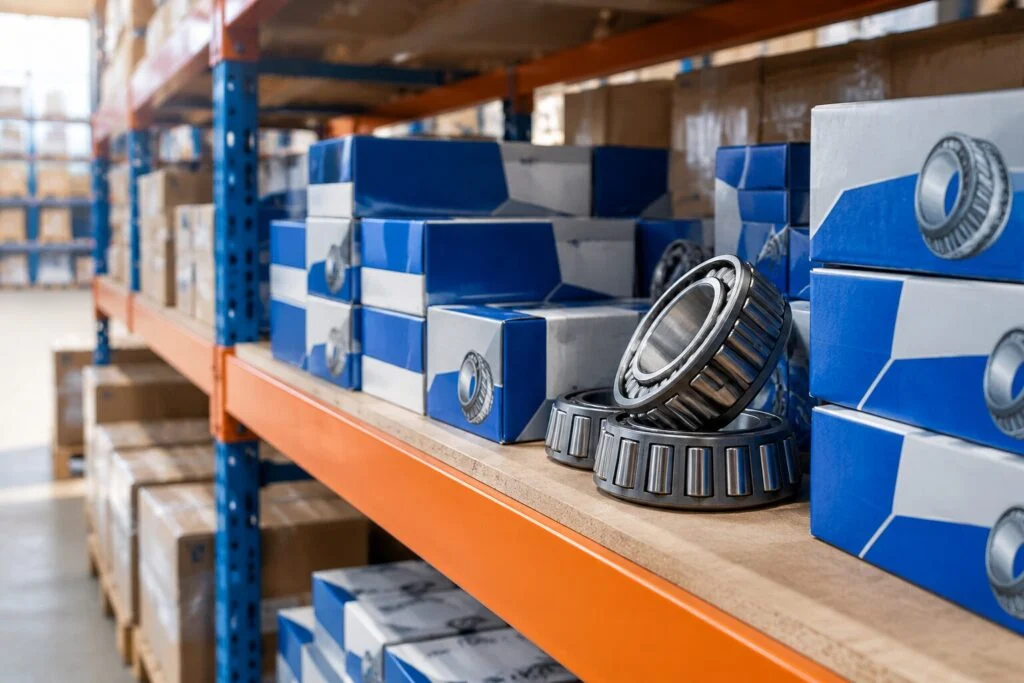
Deep-groove ball bearings and tapered roller bearings serve fundamentally different load paths, and confusing them leads to immediate mechanical failure. The automotive industry relies on specific bearing architectures to handle radial and axial loads distinctively.
Deep-groove ball bearings are the workhorses of electric motors and auxiliary drives. They handle moderate radial loads and some axial load in both directions. Their simplicity makes them cost-effective, but they lack the capacity for heavy combined loads. In contrast, tapered roller bearings are engineered for wheel applications where heavy radial and significant axial loads occur simultaneously, such as during cornering. [NEED_CITE: load capacity differences between bearing types per ISO standards]
Consider a scenario where a repair shop orders a deep-groove bearing for a heavy-duty truck wheel hub because the part number looked similar. The bearing might fit the shaft diameter, but under the lateral stress of turning, the balls will skid rather than roll. This generates excessive heat, leading to rapid cage failure.
| Bearing Type | Primary Load Capacity | Typical Automotive Application | Sealing Complexity |
|---|---|---|---|
| Deep-Groove Ball | Radial + Light Axial | Alternators, Tensioners, Pumps | Low to Medium |
| Tapered Roller | Heavy Radial + Heavy Axial | Wheel Hubs, Differential Pinions | High (often separate seal) |
| Angular Contact | High Axial (One Direction) | Wheel Hub Assemblies (Gen I/II) | Integrated in Unit |
When sourcing these components, verifying the internal geometry is as crucial as checking the outer dimensions. A mismatch here does not just cause noise; it causes safety hazards. For wholesalers, maintaining a clear distinction in your automotive bearing glossary database ensures that customers receive the correct architecture for their specific load requirements.
What do critical bearing suffixes actually mean?
A single letter suffix difference completely changes the internal sealing and application limits. Many ordering errors stem from ignoring the suffixes that denote seal type and internal clearance. These are not optional extras; they are integral to the bearing’s performance envelope.
The most common confusion arises between ZZ and 2RS. ZZ indicates metal shields on both sides. These shields protect against large contaminants but offer minimal protection against water or fine dust. They also have lower friction, making them suitable for high-speed applications like alternators. 2RS denotes rubber seals on both sides. These provide superior protection against moisture and contaminants but generate more heat due to friction. Installing a 2RS bearing in a high-speed alternator application can lead to overheating and premature grease breakdown. [NEED_CITE: friction and temperature rise data for sealed bearings]
Internal clearance is another critical factor, often denoted by C3. Standard clearance is sufficient for most applications, but C3 offers greater internal space. This is vital for applications with significant thermal expansion, such as wheel hubs that experience high braking temperatures. Using a standard clearance bearing in a high-heat environment can cause the inner ring to expand, eliminating the internal play and leading to seizure.
| Suffix Code | Seal/Clearance Type | Protection Level | Friction/Heat Generation | Best Use Case |
|---|---|---|---|---|
| ZZ | Metal Shield | Low (Large particles) | Low | High-speed motors, Alternators |
| 2RS | Rubber Seal | High (Water/Dust) | Medium | Wheel hubs, Chassis components |
| C3 | Increased Clearance | N/A | N/A | High-temperature applications |
Ignoring these suffixes is a frequent cause of warranty claims. A customer might order a bearing based on the base number alone, missing the critical suffix that defines its environmental resilience. By integrating these suffix meanings into your automotive bearing glossary, you ensure that every part selected matches the operational reality of the vehicle.
How to identify hub unit generations correctly?
Hub unit generations are defined by flange integration and sensor compatibility, not just bolt patterns. Misidentifying the generation of a hub unit is a leading cause of order delays and returns in the aftermarket. The evolution from Gen I to Gen III represents a shift from simple bearing replacement to integrated module swapping.
Generation I hub units consist of two separate bearings pressed into the hub. They require precise pressing tools and skill to install. Generation II integrates the bearing into a single unit with a flange, simplifying installation but still requiring separate ABS sensor rings in many cases. Generation III takes integration further, combining the bearing, hub, and often the ABS sensor into a single bolt-on module. [NEED_CITE: structural evolution of wheel bearing hub units]
The confusion often lies in the flange type. A Gen II unit might have a four-bolt flange, while a Gen III unit for the same vehicle model might have a five-bolt flange or a different stud pattern. Ordering a Gen II when a Gen III is required means the mechanic cannot bolt the unit to the knuckle. Conversely, ordering a Gen III when a Gen II is needed results in a unit that does not fit the existing brake rotor or caliper bracket.
In my experience, bulk orders for hub units require careful verification of the generation. A European repair group once ordered a container of hub units based on the vehicle model year alone. They received Gen II units for vehicles that had been updated to Gen III mid-production. The result was a warehouse full of incompatible stock. We resolved this by implementing a cross-reference check that included flange bolt count and sensor presence. Our one-stop sourcing for genuine Hub Unit III and cross-brand consultation helps prevent such mismatched bulk orders by verifying these physical attributes before shipment.
Understanding these generational differences is essential for any serious automotive bearing glossary. It moves the conversation from simple part numbers to functional compatibility, ensuring that the part fits not just the shaft, but the entire assembly.
Why do slang terms cause ordering failures?
Slang terms often describe physical shapes rather than exact technical specifications. Workshop language is efficient for mechanics but dangerous for procurement. Terms like "pancake," "donut," or "monk head" refer to visual characteristics that can apply to multiple distinct parts.
For instance, "pancake" might refer to a thin thrust bearing or a specific type of clutch release bearing. Without the technical part number, the supplier is guessing. In the case of the "monk head" incident, the term described the rounded, flanged appearance of the hub unit. However, without the technical designation, it could easily be confused with other spherical components. This ambiguity leads to shipping the wrong item, resulting in container detention costs and frustrated customers. [NEED_CITE: impact of communication errors on supply chain efficiency]
To mitigate this, successful distributors maintain a mapping system in their automotive bearing glossary that links common slang to technical part numbers. When a customer uses a slang term, the staff must immediately verify the application, vehicle model, and preferably, the old part number. This step transforms a vague request into a precise order.
| Slang Term | Possible Technical Parts | Risk of Error | Verification Method |
|---|---|---|---|
| Monk Head | Hub Unit III, Tie Rod End | High | Check flange bolts and studs |
| Pancake | Thrust Bearing, Clutch Bearing | Medium | Check thickness and ID/OD |
| Donut | Center Support Bearing, Coupling | Medium | Check mounting brackets |
By treating slang as a starting point for investigation rather than a definitive identifier, you protect your business from costly errors. This approach ensures that your automotive bearing glossary serves as a bridge between informal workshop language and formal engineering standards.
Conclusion
Precision in terminology prevents precision in failure. Mastering the nuances of suffixes, generations, and technical definitions is not merely an academic exercise; it is a commercial necessity. By integrating these insights into your daily operations, you reduce returns, enhance customer trust, and streamline your supply chain. Use this automotive bearing glossary as a foundational tool to decode the complexities of the aftermarket and ensure every part matches its intended application.