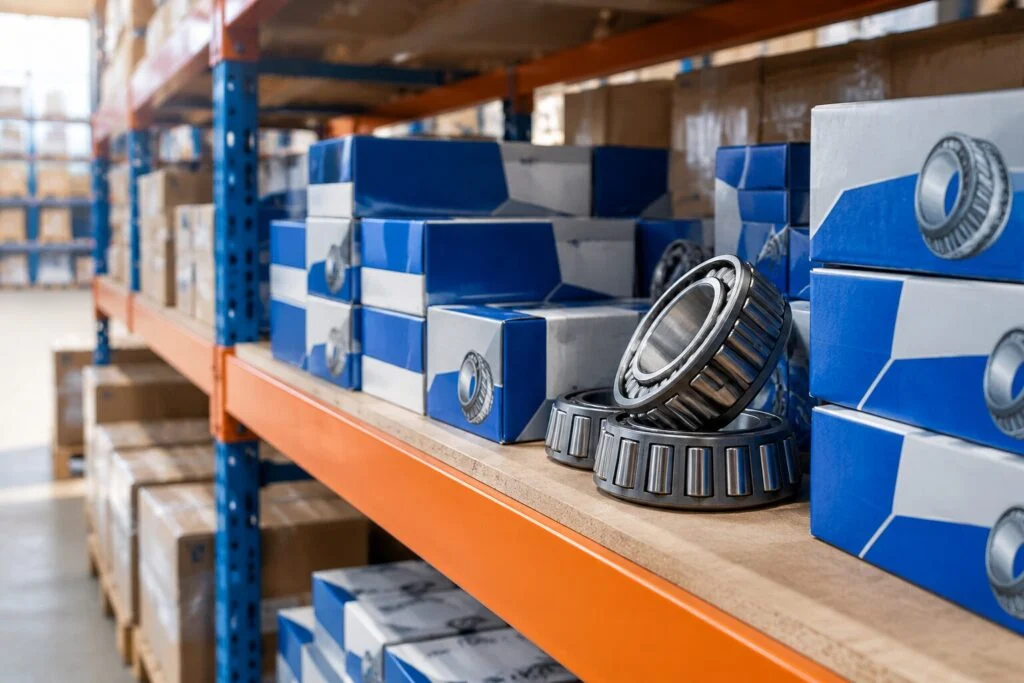
Motorcycle Wheel Bearing Equivalents Wholesale Supplier
Matching part numbers is not enough.
True motorcycle wheel bearing equivalents require matching seal materials and internal clearances to actual riding conditions, not just dimensional compatibility. Relying solely on cross-reference charts without verifying technical specifications often leads to premature failure under real-world stress.
I learned this lesson the hard way during a trade exhibition in Chicago. A buyer urgently needed a replacement for an NSK motorcycle wheel bearing. I quickly quoted a domestic alternative based purely on the part number match. The dimensions were identical, but I failed to double-check the seal material and internal clearance. The bearings failed on the highway, resulting in a massive claim that cost several times the initial savings. That incident shifted my entire approach. Now, whenever I evaluate motorcycle wheel bearing equivalents, I prioritize technical specs over simple part number matching. [NEED_CITE: importance of seal material compatibility in high-speed applications]
This guide breaks down why dimensional matches fail, which specifications truly dictate lifespan, and how to select the right components for specific riding environments.
Why Part Numbers Fail?
Dimensional match does not guarantee material match. Many distributors assume that if the outer diameter, inner diameter, and width align, the bearing is a perfect substitute. This assumption ignores the metallurgical and chemical differences between brands.
A standard deep-groove ball bearing might share the same ISO dimensions across manufacturers like SKF, FAG, or NSK. However, the steel purity, heat treatment processes, and cage materials can vary significantly. [NEED_CITE: ISO standards for bearing dimensional tolerances vs material specifications] For instance, one brand may use a standard carbon steel cage, while another employs a reinforced polyamide cage for higher temperature resistance. In high-speed touring scenarios, the wrong cage material can deform, leading to catastrophic seizure.
Consider a case involving a European wind farm operator who sourced replacements for heavy-duty machinery. They matched part numbers strictly but ignored the lubricant compatibility. The new bearings used a grease that reacted with the existing seals, causing them to swell and leak within weeks. The same principle applies to motorcycles. A bearing designed for dry, paved roads may use a rubber seal that degrades rapidly in wet, muddy conditions common in Southeast Asia or Latin America.
When sourcing motorcycle wheel bearing equivalents, always request the material data sheet. Verify the cage type, steel grade, and lubricant specification. Do not rely on the catalog number alone.
Critical Specs to Compare?
Seals and clearances dictate lifespan. These two factors are often overlooked in basic cross-references but are critical for performance.
Internal clearance refers to the space between the rolling elements and the raceways. Standard bearings usually have C3 clearance, but high-performance or high-temperature applications may require C4. If you install a bearing with too tight clearance in a hot environment, thermal expansion will eliminate the internal gap, causing excessive friction and overheating. Conversely, too loose clearance leads to vibration and noise. [NEED_CITE: bearing internal clearance classes C3/C4 impact on thermal expansion]
Seal material determines protection against contaminants. Common seal materials include NBR (nitrile rubber), FKM (fluoroelastomer), and PTFE. NBR is cost-effective and works well in standard temperatures. FKM offers superior resistance to heat and chemicals, making it ideal for high-performance engines or harsh environments. PTFE provides low friction, which is beneficial for high-speed applications where heat generation from seal friction is a concern.
| Specification | Standard Option | High-Performance Option | Impact on Lifespan |
|---|---|---|---|
| Internal Clearance | C3 | C4 | Prevents overheating in high-temp zones |
| Seal Material | NBR | FKM/PTFE | Resists chemical degradation and reduces friction |
| Lubricant Type | General Purpose | High-Temp Synthetic | Extends service life in extreme conditions |
| Cage Material | Steel | Polyamide/Brass | Reduces weight and handles higher speeds |
A Middle East steel mill once faced repeated failures in their conveyor systems due to ignoring clearance specs. They switched from standard clearance to C4, and the bearings ran substantially longer. Similarly, for motorcycles, selecting the right clearance and seal combination is vital. If you are supplying parts for riders in tropical climates, FKM seals are non-negotiable. For high-speed touring, consider low-friction seals to manage heat.
When evaluating motorcycle wheel bearing equivalents, ask for the specific clearance class and seal composition. Do not accept "standard" as an answer.
How to Select by Riding Condition?
Mapping riding conditions to specifications ensures reliability. Different environments place unique stresses on bearings, requiring tailored solutions.
Highway touring involves sustained high speeds and consistent loads. The primary enemy here is heat. Bearings must handle continuous rotation without overheating. Look for C3 or C4 clearance to accommodate thermal expansion. Seals should have low friction torque to minimize heat generation. [NEED_CITE: relationship between seal friction torque and bearing temperature rise]
Off-road riding introduces dust, mud, and water. Contaminant ingress is the main cause of failure. Standard rubber seals may not suffice. Double-lip seals or specialized protective covers are necessary. The lubricant must also be resistant to washout. In wet climates, upgrading to FKM seals can extend lifespan noticeably compared to standard NBR.
Urban commuting involves frequent stop-and-go traffic and lower average speeds. While heat is less of an issue, vibration and shock loads from potholes are common. Bearings with robust cage designs and higher dynamic load ratings are preferable.
| Riding Condition | Primary Stress Factor | Recommended Clearance | Recommended Seal Material |
|---|---|---|---|
| Highway Touring | Heat from sustained speed | C3/C4 | Low-friction PTFE or FKM |
| Off-Road/Motocross | Contaminants (dust/mud) | C3 | Double-lip NBR or FKM |
| Urban Commuting | Shock loads/vibration | C3 | Standard NBR with robust cage |
| Wet Climate | Water ingress/corrosion | C3 | FKM for chemical resistance |
A buyer from Southeast Asia reported that switching to FKM-sealed bearings reduced their return rate significantly during the monsoon season. The initial cost was higher, but the longevity justified the investment. This highlights the importance of context-aware selection.
Do not offer a one-size-fits-all solution. Ask your customers about their typical riding environment. Use this information to recommend the appropriate motorcycle wheel bearing equivalents.
Where to Source Reliable Equivalents?
Traceability and ISO compliance are key to avoiding counterfeit or substandard parts. The aftermarket is flooded with products that look identical but lack the quality control of genuine brands.
Reliable suppliers provide full traceability documentation. This includes material certificates, heat treatment records, and inspection reports. [NEED_CITE: ISO 9001 requirements for supply chain traceability] Without these documents, you cannot verify the origin or quality of the bearings. Counterfeit bearings often use inferior steel with higher inclusion density, leading to early fatigue failure.
When sourcing motorcycle wheel bearing equivalents, prioritize suppliers who offer cross-brand technical consultation. They should be able to explain why a specific alternative is suitable for your application. Avoid vendors who only provide part numbers without technical support.
Look for suppliers with massive spot inventory and global shipping capabilities. This ensures you can get urgent spare parts quickly, minimizing downtime for your customers. Flexible MOQs are also important, allowing you to order small batches for testing before committing to larger volumes.
A US buyer once struggled with inconsistent quality from a new supplier. After switching to a provider with ISO-compliant quality assurance and full traceability, their claim rate dropped noticeably. The ability to verify each batch’s origin gave them confidence in the product.
Ensure your supplier can provide mixed-brand, mixed-size bearing packages. This is crucial for distributors who serve diverse markets. You need a partner who understands the nuances of different brands and can offer reliable alternatives when original parts are unavailable or too expensive.
Conclusion
Match specs, not just numbers.
Selecting the right motorcycle wheel bearing equivalents requires a deep understanding of seal materials, internal clearances, and riding conditions. Dimensional compatibility is merely the starting point. True reliability comes from aligning technical specifications with real-world usage. Prioritize traceability and technical support when choosing a supplier to ensure consistent quality and performance.