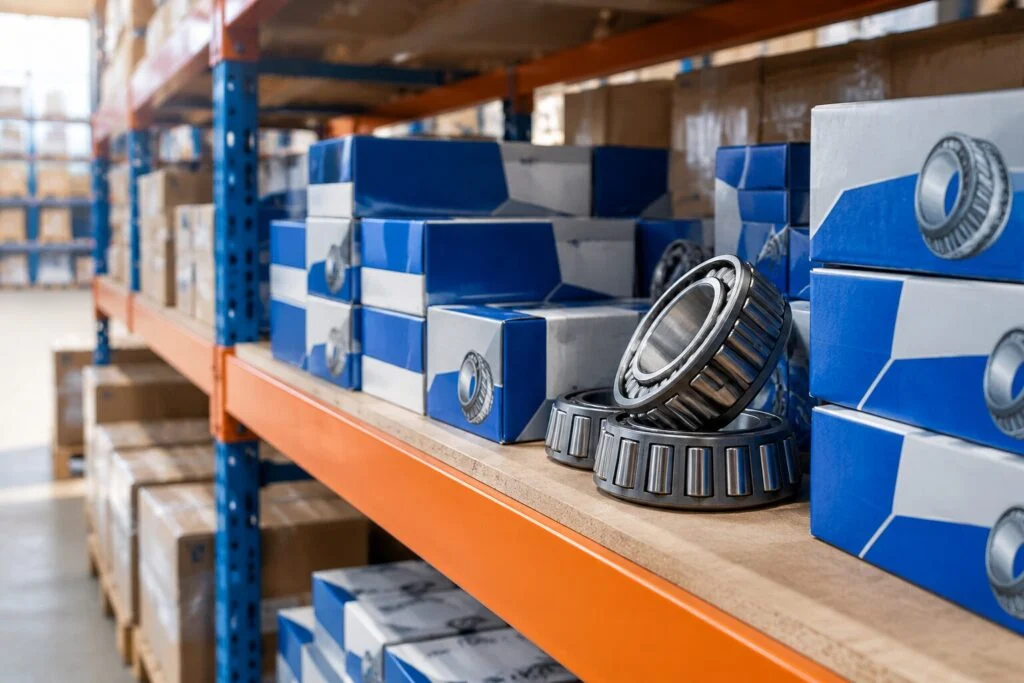
Genuine Bearings for Rally & Motorsport Cars | Global Wholesale Supplier
Price does not guarantee survival on the track; traceability does.
Rally and motorsport applications require genuine high-performance bearings with verified OEM traceability, specifically from manufacturers like SKF and FAG, to withstand extreme thermal loads and multi-axis G-forces that standard automotive components cannot endure. Sourcing must prioritize original customs declarations and batch-specific documentation over lowest-cost alternatives to prevent catastrophic drivetrain failure.
The smell of burnt grease is distinct. It is sharp, acrid, and signals a mechanical death sentence. I remember standing in the pit lane of a desert rally stage years ago, watching a team dismantle a rear hub assembly. The bearing had not just failed; it had disintegrated. The rollers were fused into a single lump of steel, and the cage was shattered. The team had sourced what they believed were premium racing components from a secondary market supplier to cut costs. What they received were high-quality counterfeits. Under the sustained high RPMs and extreme ambient heat of the desert, the micro-defects in the counterfeit steel expanded beyond tolerance limits. The result was not just a lost race, but a mid-six-figure loss in chassis damage and a severe safety risk for the driver. That incident shifted my entire approach to sourcing. In motorsport, a bearing is not a commodity; it is a critical safety component where micron-level precision determines whether power is transferred to the wheels or dissipated as destructive heat.
This reality defines the search for reliable motorsport bearing suppliers. Teams and distributors are not merely looking for parts; they are seeking insurance against mechanical failure. The difference between a genuine component and a sophisticated fake often lies in the metallurgical purity and the precision of the internal clearance, factors that are invisible to the naked eye until it is too late.
Why Standard Bearings Fail in Rally Environments?
Standard automotive bearings are engineered for predictable road loads, not the chaotic shock profiles of rally stages.
Rally cars operate in an environment that defies normal engineering assumptions. A standard passenger vehicle bearing is designed to handle vertical loads and moderate cornering forces on paved surfaces. In contrast, a rally car experiences sudden, massive shock loads from jumps, deep ruts, and loose surfaces. These impacts generate dynamic loads that can exceed the static load ratings of standard components by several times. [NEED_CITE: dynamic load rating calculations per ISO 281]
Furthermore, thermal management is a critical failure point. In a long desert stage, brake heat soaks into the wheel hubs, raising the operating temperature of the bearings significantly. Standard lubricants break down, and the steel itself expands. If the internal clearance of the bearing is not precisely calculated to account for this thermal expansion, the rollers will bind. This binding creates friction, which generates more heat, leading to a thermal runaway event that melts the bearing assembly. Genuine high-performance rally bearings are manufactured with specific internal clearances, often designated as C3 or C4, to accommodate this expansion without losing structural integrity. [NEED_CITE: thermal expansion limits in high-speed bearings]
The material quality also differs fundamentally. Racing bearings use vacuum-degassed steel with strictly controlled inclusion levels. Inclusions are non-metallic particles trapped in the steel during manufacturing. In a standard bearing, a small inclusion might cause a minor noise issue. In a high-RPM racing application, that same inclusion acts as a stress concentrator, initiating a fatigue crack that propagates rapidly under cyclic loading. The result is spalling and eventual disintegration. This is why generic "racing" bearings sold without brand verification often fail prematurely. They lack the metallurgical consistency required for extreme duty cycles.
For teams sourcing genuine SKF FAG racing bearings, the value lies in this consistent metallurgy. Every batch is tested for hardness and purity, ensuring that the component can survive the unpredictable violence of a rally stage. Without this verification, the bearing is a gamble with poor odds.
Critical Bearing Types in Motorsport Applications
Not all bearings are created equal; angular contact and tapered designs handle the complex multi-axis loads inherent in racing.
In a rally car, forces do not act in a single direction. Cornering generates lateral loads, acceleration creates axial thrust, and bumps introduce radial shocks. A standard deep-groove ball bearing, common in household appliances and light automotive applications, cannot efficiently manage these combined loads. It will experience premature wear on the raceways and fail under the side-loading conditions typical of aggressive driving.
Angular contact ball bearings are frequently used in high-speed applications such as wheel hubs and transmission inputs. Their design allows them to support significant axial loads in one direction while maintaining high rotational speed capabilities. The contact angle between the balls and the raceways is optimized to transfer force efficiently, reducing slip and heat generation. However, these bearings require precise preload adjustment. Too little preload leads to vibration and skidding; too much causes excessive heat and rapid wear. This sensitivity demands genuine SKF FAG racing bearings that meet strict tolerance classes, ensuring that the preload remains stable throughout the race. [NEED_CITE: preload effects on bearing life in angular contact designs]
Tapered roller bearings are another staple in motorsport, particularly in differential and heavy-load wheel applications. Their conical shape allows them to handle heavy combined radial and axial loads. The large contact area between the rollers and raceways distributes stress effectively, making them robust against shock loads. However, they are sensitive to misalignment. If the housing or shaft is not machined to precise tolerances, the rollers will edge-load, causing localized stress concentrations that lead to early failure.
Sourcing these components requires more than just matching part numbers. It requires understanding the specific load cases of the vehicle. A motorsport bearing suppliers must provide technical data sheets that confirm the dynamic load ratings and limiting speeds match the application. Using a bearing with insufficient capacity is a common error among amateur teams, leading to repeated failures that are often misdiagnosed as suspension issues.
The Hidden Cost of Counterfeit Racing Bearings
Micro-defects in counterfeit parts cause disintegration at high RPMs, risking driver safety and resulting in catastrophic financial loss.
The market for racing parts is flooded with counterfeits. These items often look identical to genuine products, featuring correct packaging and even convincing logos. However, the internal quality is vastly inferior. Counterfeiters typically use lower-grade steel with higher inclusion counts and less precise grinding processes. The surface finish of the raceways may appear smooth but contains microscopic peaks and valleys that increase friction and wear.
In a high-performance environment, these defects are fatal. At high RPMs, the centrifugal forces acting on the rolling elements are immense. Any imbalance or surface irregularity amplifies vibration, which accelerates fatigue. A genuine bearing might last for thousands of hours under normal conditions, but a counterfeit unit can fail within minutes under racing loads. The failure mode is often sudden and violent, sending shrapnel through the housing and damaging adjacent components like sensors, wiring, and suspension arms.
I have seen teams spend tens of thousands on engine rebuilds only to lose the car because a cheap bearing seized in the alternator or water pump. The cost of the genuine bearing is negligible compared to the downtime and repair bills. Moreover, the safety implication is severe. A wheel bearing failure at high speed can lead to loss of control, endangering the driver and co-driver. This is why traceability is non-negotiable.
When evaluating motorsport bearing suppliers, ask for proof of origin. Genuine genuine SKF FAG racing bearings come with batch numbers that can be traced back to the factory. Suppliers who cannot provide this documentation are likely selling gray market or counterfeit goods. The risk is not worth the savings.
How to Source Genuine Motorsport Bearings Reliably
Demand original customs declarations and traceability documents to verify authenticity and ensure racing safety.
Sourcing genuine components requires a rigorous verification process. The first step is to identify suppliers who specialize in industrial and automotive bearings with a focus on authenticity. Generalist auto parts sellers often lack the technical knowledge and supply chain controls necessary for motorsport applications. Look for suppliers who stock multiple premium brands such as SKF, FAG, NSK, and TIMKEN, as this indicates a broader network and deeper inventory.
Request full traceability documentation for every order. This includes the original manufacturer’s certificate of conformity and, crucially, the customs declaration showing the import of genuine goods. These documents prove that the bearings were sourced from authorized channels and not diverted from questionable origins. A reputable supplier will provide these without hesitation. If a supplier refuses or offers vague excuses, consider it a red flag.
Another key factor is inventory management. Motorsport teams often need parts urgently. A supplier with a large spot inventory of standard and special part numbers can fulfill emergency orders quickly, reducing downtime. Consolidating orders from multiple brands into a single shipment can also streamline logistics and reduce shipping costs. This is particularly useful for teams that require a mix of high-performance rally bearings for different systems, such as the engine, transmission, and wheels.
Technical support is also essential. A good supplier will offer cross-brand equivalent model consultation, helping teams find suitable replacements if a specific part is unavailable. They should also provide guidance on proper installation and maintenance, such as recommended lubricants and torque settings. This level of service ensures that the bearings perform as intended, maximizing their lifespan and reliability.
For distributors and teams, building a long-term relationship with a trusted motorsport bearing suppliers is an investment in performance. It eliminates the guesswork and risk associated with purchasing critical components. By prioritizing traceability and technical expertise, you ensure that every bearing installed in your vehicle is capable of withstanding the extreme demands of rally competition.
Conclusion
Authenticity is the only metric that matters when failure means disaster.
Sourcing genuine SKF FAG racing bearings and other premium components requires vigilance, documentation, and a rejection of false economies. The extreme conditions of rally racing expose every weakness in materials and manufacturing. By partnering with verified motorsport bearing suppliers who prioritize traceability and technical accuracy, teams protect their drivers, their budgets, and their competitive integrity.