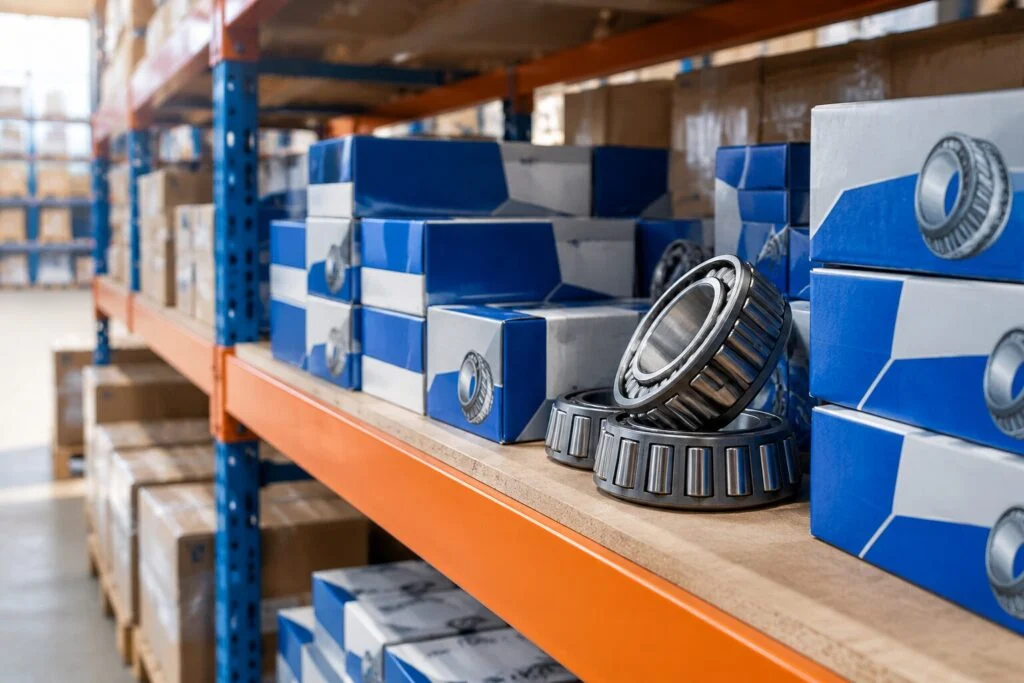
Genuine Bearings Wholesale Supplier for Parts Retailers
Discounts do not clear customs; documentation does.
Marketing support for parts retailers is not about promotional flyers or price cuts. It is the provision of unbroken traceability documents, official technical datasheets, and cross-brand equivalence charts that allow local distributors to prove authenticity to end-users and smooth customs clearance for mixed-brand container shipments.
I still remember the humidity in Monterrey, Mexico, and the sinking feeling in my gut as I watched a customs officer flip through a stack of invoices that did not match the physical cargo. We had consolidated a full container of deep-groove ball bearings from several premium brands to help a local parts retailer optimize their inventory costs. The logic was sound: mix high-turnover SKF and FAG units with cost-effective domestic lines to fill the container efficiently. However, we failed to attach the complete chain of custody documents for every single brand in the mix. The result was not just a delay; it was a near-seizure of the entire shipment under suspicion of counterfeit goods. The retailer paid significant storage fees and nearly lost the trust of their biggest industrial client. That incident reshaped my understanding of what a genuine bearings wholesale supplier for parts retailers actually provides. It is not just metal rings and rolling elements; it is the paper trail that proves they are real. [NEED_CITE: importance of traceability documentation in international bearing trade]
The market is flooded with suppliers who claim to offer marketing support, but most misunderstand the assignment. They send digital banners or generic catalogs. These are useless when a workshop manager asks for proof that the spherical roller bearing in their crusher is not a refurbished fake. Real support empowers the retailer to answer technical questions and legal queries instantly. This article breaks down how proper documentation and technical data become your strongest sales tools, ensuring that your position as a reliable genuine bearings wholesale supplier for parts retailers is built on verifiable trust rather than just competitive pricing.
What marketing materials do parts retailers actually need to win local workshops?
Technical datasheets and cross-brand equivalence charts build significantly more trust than mere price lists.
When a local distributor walks into a repair workshop or a factory maintenance office, they are often met with skepticism. End-users have been burned by counterfeit bearings that fail prematurely, causing costly downtime. A glossy brochure promising "high quality" means nothing in this environment. What matters is data. Providing official technical datasheets from the original manufacturers allows the retailer to speak the same language as the engineers and maintenance managers. These documents detail load ratings, limiting speeds, and dimensional tolerances, providing an objective basis for selection. [NEED_CITE: role of technical datasheets in B2B bearing procurement decisions]
Furthermore, many maintenance scenarios require urgent replacements where the exact original brand is unavailable or too expensive. Here, cross-brand equivalence charts are invaluable. If a customer needs an NSK bearing but you only have an NTN equivalent in stock, a verified equivalence chart shows that the dimensions and performance metrics match. This turns a potential lost sale into a successful consultation. It positions the retailer not just as a box-mover, but as a technical partner who understands application requirements.
The contrast between ineffective and effective marketing materials is stark:
| Material Type | Content Focus | End-User Perception | Trust Impact |
|---|---|---|---|
| Generic Promotional Flyer | Price discounts, broad brand logos | Sales pitch, low credibility | Low |
| Official Technical Datasheet | Load ratings, tolerances, material specs | Engineering validation, professional | High |
| Cross-Brand Equivalence Chart | Verified alternative part numbers | Problem-solving, expertise | High |
| Unverified Stock List | Part numbers only | Inventory check, no context | Neutral |
By equipping retailers with these tools, a genuine bearings wholesale supplier for parts retailers enables them to close deals based on technical merit. This is particularly crucial in regions where aftermarket fraud is prevalent. When a retailer can pull up a PDF showing the exact C3 clearance specification or the steel grade certification, they bypass the suspicion phase entirely. This form of support is scalable and does not require constant sales intervention, making it a highly efficient marketing engine.
How to ensure mixed-brand container shipments pass customs smoothly?
Complete traceability docs and origin certificates must accompany every mixed batch without exception.
Consolidating different brands into one container is a common strategy for wholesalers to reduce shipping costs per unit. However, this practice increases customs scrutiny. Customs officers are trained to look for inconsistencies in mixed shipments. If a container holds SKF, TIMKEN, and ZWZ bearings, the documentation must clearly delineate which boxes belong to which brand and provide the corresponding proof of origin for each. [NEED_CITE: customs compliance guidelines for mixed-brand industrial imports]
Failure to provide this granular level of documentation can lead to severe consequences. As seen in the Monterrey case, missing papers for even a small portion of the cargo can jeopardize the entire container. The risk is not just financial; it is reputational. A delayed shipment means a halted production line for the end-user, and the blame falls on the retailer. Therefore, the marketing support provided by the upstream supplier must include a rigorous document management system.
Key elements of a customs-ready documentation package include:
- Brand-Specific Invoices: Separate line items or annexes for each brand to clarify value and origin.
- Certificate of Origin: Issued by the relevant chamber of commerce or manufacturer, matching the brand of the goods.
- Traceability Codes: Batch numbers that link the physical product to the manufacturing date and facility.
- Authorization Letters: Where applicable, proof that the supplier is authorized to distribute the specific brands.
A genuine bearings wholesale supplier for parts retailers must treat these documents as part of the product itself. They are not administrative afterthoughts; they are the keys that unlock the border. Without them, the best-priced bearings in the world are stuck in a port, accruing demurrage charges. By ensuring that every mixed batch is accompanied by a complete, auditable paper trail, suppliers remove the biggest barrier to international trade for their retail partners. This reliability becomes a core part of the retailer’s value proposition to their own customers.
Why is flexible MOQ crucial for retailer inventory turnover?
Single-unit to full-container flexibility prevents dead stock while meeting urgent MRO demands.
Inventory management is the tightrope walk of any parts retailer. Holding too much stock ties up capital and risks obsolescence; holding too little leads to missed sales and dissatisfied customers. Traditional brand distributors often impose high minimum order quantities (MOQs), forcing retailers to buy in bulk even for slow-moving items. This model does not work for the diverse needs of local markets, where demand can be sporadic and unpredictable. [NEED_CITE: impact of MOQ flexibility on SME distributor inventory turnover]
A genuine bearings wholesale supplier for parts retailers addresses this by offering tiered MOQ options. For fast-moving standard sizes, full container loads make economic sense. For specialized or slow-moving precision bearings, the ability to order single units or small batches is critical. This flexibility allows retailers to maintain a broad catalog without the financial burden of excessive inventory. It enables them to say "yes" to urgent, one-off replacement requests from local factories, which often carry higher margins and build strong customer loyalty.
Consider the case of a mining operation in a remote area. When a critical conveyor belt bearing fails, they need one specific tapered roller bearing immediately. They do not want to buy a pallet of ten. A retailer who can source that single unit quickly becomes their go-to partner for all future needs. This agility is only possible if the upstream supplier supports small-batch consolidation. By combining orders from multiple retailers or mixing slow-movers with fast-movers in a single shipment, the supplier absorbs the logistical complexity, passing on the benefit of availability to the retailer. This approach transforms inventory from a liability into a strategic asset.
How does technical selection support boost your resale success?
Application guidance and failure analysis turn you from a box-mover to a trusted local partner.
Selling a bearing is easy; selling the right bearing for a specific application is hard. Many failures occur not because the bearing was defective, but because it was misapplied. A retailer who simply takes orders will eventually face returns and complaints. A retailer who offers technical selection support builds long-term relationships. This is where the expertise of the supplier becomes a direct marketing tool for the retailer. [NEED_CITE: correlation between technical support and customer retention in industrial distribution]
When a retailer faces a complex query—such as selecting a bearing for a high-vibration screen or a high-temperature fan—they need more than a catalog. They need application guidance. A genuine bearings wholesale supplier for parts retailers provides access to engineering resources that can analyze operating conditions, load types, and environmental factors. This support helps the retailer recommend the optimal solution, whether it is a spherical roller bearing with a special cage or a cylindrical roller bearing with enhanced heat treatment.
Moreover, when a failure does occur, the ability to perform or facilitate a failure analysis is invaluable. Identifying whether the cause was lubrication error, misalignment, or fatigue helps the end-user prevent recurrence. This level of service differentiates a professional distributor from a simple trader. It justifies premium pricing and fosters deep trust. By leveraging the technical backbone of their supplier, retailers can elevate their own brand status in the local market. They become consultants, not just vendors. This transformation is the ultimate goal of effective marketing support, creating a moat around the retailer’s business that competitors cannot easily cross.
Conclusion
Authenticity and documentation are the true currency of trust in the bearing trade.
Marketing support for parts retailers is fundamentally about removing friction from the sales process. By providing complete traceability documents, technical datasheets, and flexible sourcing options, a genuine bearings wholesale supplier for parts retailers empowers local distributors to operate with confidence. This approach ensures that every transaction, whether a single emergency spare or a full container consolidation, is backed by verifiable quality and professional expertise. In a market saturated with uncertainty, this clarity is the most valuable asset a retailer can offer.