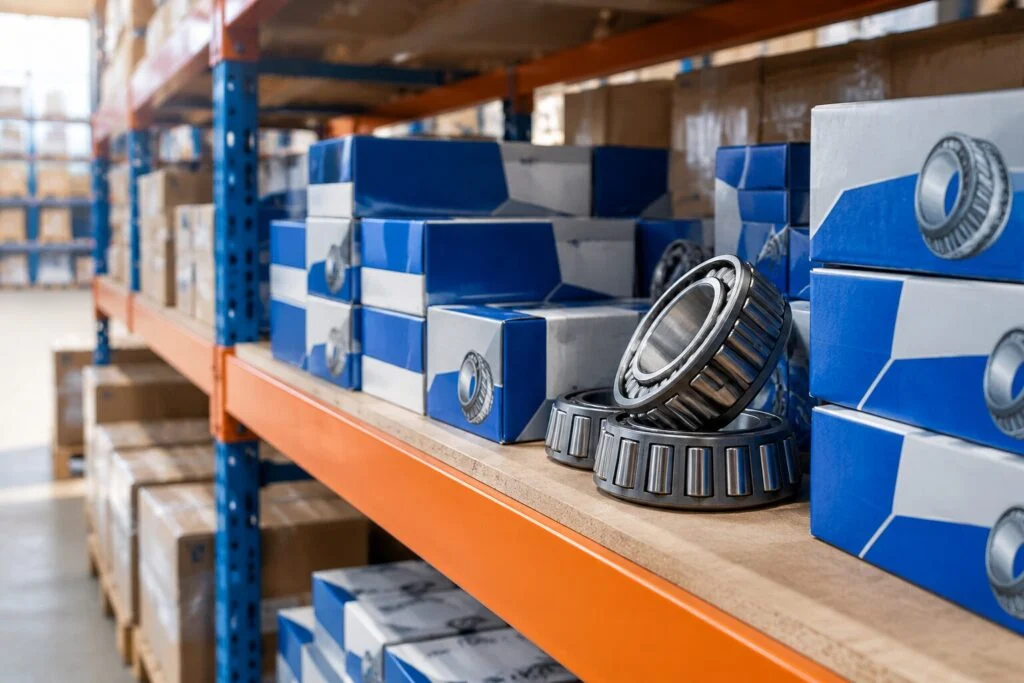
Genuine Bearing Supplier: Mixed Vehicle Range Parts Store Orders Wholesale
The strongest outer carton cannot save bearings from rust if they touch each other inside the box.
Fulfilling mixed vehicle range bearing orders requires strict inner separation, anti-rust packaging, and accurate cross-brand matching to prevent transit damage and ensure accurate fulfillment. Without these measures, friction during sea freight causes surface corrosion and brinelling, leading to high claim rates regardless of the bearing’s initial quality.
I still remember the smell of that container when it opened in Rotterdam. It was not the scent of fresh steel or protective oil, but the sharp, metallic tang of oxidation. Years ago, I managed a shipment for an auto parts distributor who wanted to consolidate hundreds of SKUs into a single load to save on logistics. The order included deep-groove ball bearings for wheel hubs, tapered roller bearings for transmissions, and various needle bearings for engine assemblies. We packed them tightly in wooden crates, assuming the sturdy exterior would withstand the ocean journey. We were wrong. The vibration of the ship caused the bearings to rub against one another. The protective oil film was wiped away by constant friction, and the humid sea air did the rest. By the time the goods reached the warehouse, a significant portion of the inventory was scrapped due to rust and minor surface dents. That loss was not just financial; it damaged trust. Since then, I have learned that for mixed vehicle range bearing orders, the battle is won or lost inside the package, not outside it.
Handling these complex consolidations demands more than just stacking boxes. It requires a systematic approach to sorting, protecting, and verifying every single unit. A reliable genuine bearing supplier understands that mixing brands and models introduces unique risks that standard bulk shipments do not face.
Why do mixed bearing orders suffer high transit damage?
Lack of inner separation causes friction and rust, not just outer carton issues.
Many buyers assume that if the outer wooden crate or heavy-duty carton is strong enough, the contents are safe. This is a dangerous misconception. In mixed vehicle range bearing orders, the primary enemy is not external impact, but internal movement. When bearings of different sizes and weights share a container or even a single large box, heavier items like spherical roller bearings can shift during transit. If they are not physically separated from lighter components like angular contact ball bearings, the resulting collision creates micro-dents on the raceways.
Furthermore, bearings are precision components with tight tolerances. Even a microscopic scratch on the rolling element can lead to premature failure in high-speed automotive applications. [NEED_CITE: ISO 15243 classification of bearing damage modes related to handling and transport] When bearings touch directly, the hard steel surfaces act like files against each other. Over weeks of sea freight, this continuous abrasion removes the anti-corrosion coating. Once the metal is exposed, humidity penetrates, and rust forms rapidly.
A European wind farm operator once shared a similar experience with industrial bearings, where poor internal packing led to widespread corrosion despite intact outer packaging. The same principle applies to automotive parts. For a genuine bearing supplier managing mixed batches, the solution lies in rigid inner dividers. Each SKU must be isolated. Using honeycomb cardboard separators or individual plastic trays ensures that no two bearings come into direct contact. This simple step eliminates friction-based damage and preserves the integrity of the protective oil layer.
How to ensure accurate sorting for hundreds of mixed SKUs?
Standardized inner dividers and strict labeling prevent picking errors.
Auto parts stores often order small quantities of many different models to cover a wide range of vehicle makes and models. A single order might include fifty different part numbers, with only ten units of each. Picking and packing such an order manually is prone to human error. A misplaced label or a swapped box can result in a customer receiving a cylindrical roller bearing instead of a thrust bearing, causing significant downtime for their repair shop.
To mitigate this, professional consolidation services use standardized inner packaging systems. Instead of loose packing, each batch of identical bearings is placed in a clearly marked, uniform inner box. These inner boxes are then arranged in the master carton according to a pre-defined layout map. [NEED_CITE: Best practices for warehouse picking accuracy in multi-SKU environments] This method transforms a chaotic mix of parts into an organized grid.
Consider the case of a regional distributor in Southeast Asia who previously struggled with fulfillment errors. After switching to a supplier who implemented color-coded labels for different bearing series—such as blue for deep-groove ball bearings and red for tapered roller bearings—the picking error rate dropped noticeably. The visual cue allowed warehouse staff to verify the content type at a glance before sealing the box. For mixed vehicle range bearing orders, this level of organization is not a luxury; it is a necessity for maintaining operational efficiency and customer satisfaction.
What are the key packaging requirements for sea freight?
Anti-rust treatment and moisture-proof materials are mandatory for long transit.
Sea freight exposes cargo to significant temperature fluctuations and high humidity levels. Condensation forms inside containers when the temperature drops at night, creating a "container rain" effect. For bearings, which are highly susceptible to corrosion, this environment is hostile. Standard grease or light oil coatings may not be sufficient for journeys lasting several weeks.
A robust packaging protocol for mixed vehicle range bearing orders must include multiple layers of protection. First, each bearing should be wrapped in VCI (Volatile Corrosion Inhibitor) paper. This material releases vapor-phase inhibitors that form a protective molecular layer on the metal surface, preventing rust even in humid conditions. [NEED_CITE: NACE International standards for VCI packaging effectiveness] Second, the inner boxes should be sealed in polyethylene bags with desiccant packs to absorb any residual moisture. Finally, the master carton or wooden crate must be lined with waterproof plastic sheeting to create a barrier against external water ingress.
I recall a shipment destined for a coastal port in Latin America. The local climate was extremely humid, and the port storage facilities were open-air. By using double-layer VCI wrapping and heavy-duty desiccants, we ensured that the bearings arrived in pristine condition, while competing shipments without such measures suffered from surface oxidation. For a genuine bearing supplier, investing in these materials is far cheaper than handling claims for rusted stock.
How to handle cross-brand model matching efficiently?
Professional cross-reference lookup ensures correct equivalents for mixed vehicle ranges.
Auto parts stores often need to source replacements for vehicles that use bearings from various original equipment manufacturers. A single vehicle model might use SKF bearings in the front axle and NSK bearings in the rear. When a store places a mixed order, they may request equivalents to optimize costs or availability. However, substituting bearings requires precise technical knowledge. Dimensions, load ratings, and internal clearances must match exactly.
Misidentification is a common source of claims. A bearing that fits physically may not have the required fatigue life or speed rating for the application. For example, substituting a standard C3 clearance bearing for a C4 application in a high-temperature engine environment can lead to rapid seizure. [NEED_CITE: ABMA standards for bearing internal clearance and application guidelines] A competent genuine bearing supplier provides technical support to verify these cross-references. They use comprehensive databases to check dimensional equivalency and performance specifications across brands like FAG, INA, TIMKEN, and KOYO.
In one instance, a repair group in the Middle East requested a substitute for a discontinued heavy-duty truck bearing. Our technical team identified a compatible model from a different premium brand that met all the load and dimension requirements. We provided the detailed datasheet comparison to the client, ensuring they understood the equivalence. This transparency built confidence and prevented potential mechanical failures. For mixed vehicle range bearing orders, accurate cross-referencing is as critical as the physical product itself.
Conclusion
Precision in packing and verification defines the success of mixed bearing shipments.
Handling mixed vehicle range bearing orders is not merely about logistics; it is about preserving the integrity of precision engineering through rigorous protection and accurate identification. By prioritizing inner separation, employing advanced anti-rust packaging, and ensuring exact cross-brand matching, suppliers can eliminate the hidden costs of damage and error. For auto parts distributors, partnering with a source that masters these details means receiving stock that is ready for immediate sale, free from the risks of transit-induced degradation.