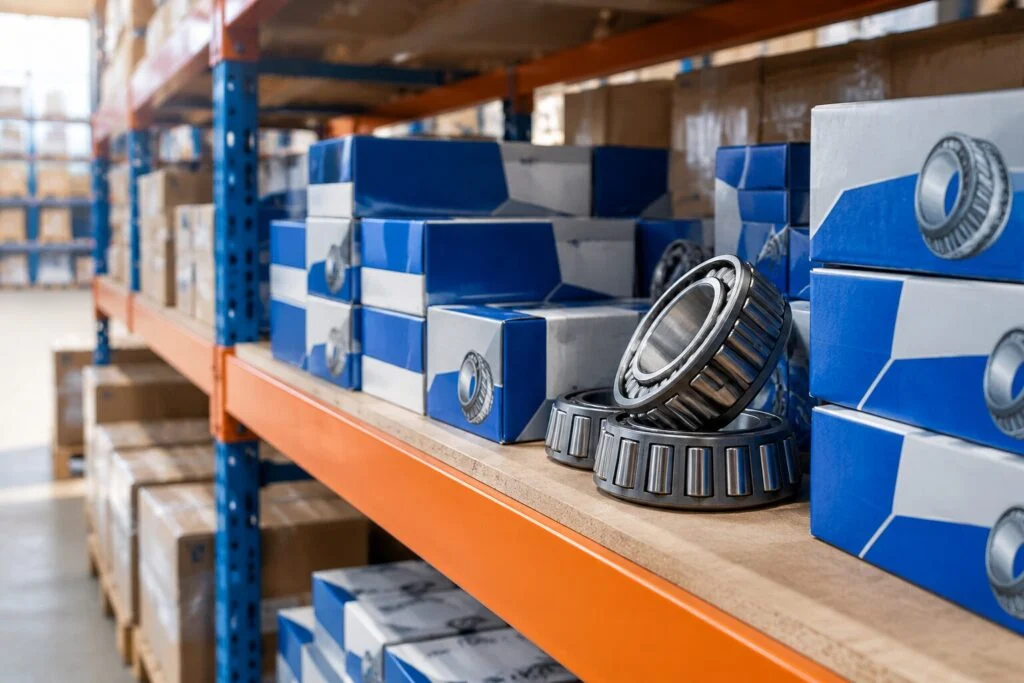
Idler Pulley Bearing Replacement: Genuine OEM Supplier
Most idler pulley bearing failures are not caused by poor lubrication, but by microscopic damage during installation.
Successful Idler Pulley Bearing Replacement demands genuine OEM parts with precise internal clearance and cage design, installed using correct press-fit techniques to survive high-dust, heavy-load environments. Substandard bearings or improper handling destroy internal geometry before the machine even starts, leading to catastrophic downtime that far outweighs initial part savings.
I still remember the smell of burnt rubber in a Chilean copper mine. A primary conveyor belt had stopped abruptly, halting the entire ore processing line. The maintenance team pointed to the seized idler roller, blaming bad grease. But when I cut open the failed bearing, the truth was visible in the metal. The cage was fractured, and the raceways showed signs of immediate spalling. This was not a lubrication issue. It was a clearance issue. The replacement bearing, a cheap non-OEM alternative, had insufficient internal clearance for the thermal expansion and heavy radial loads typical of mining operations. [NEED_CITE: relationship between internal clearance and thermal expansion in heavy load applications]. That single component cost a fraction of a genuine unit, but the resulting production halt cost the operation a mid-six-figure loss in just one shift. Since then, I have made it my practice to inspect every failed bearing personally. The debris tells a story that invoices do not.
This experience underscores a critical reality for MRO managers and site engineers: the idler pulley is not a commodity. It is a precision component operating in one of the harshest industrial environments. Understanding why these components fail and how to select the right replacement is essential for maintaining operational continuity.
Why Do Idler Pulley Bearings Fail Prematurely?
Harsh environments expose inferior cage and clearance designs that survive only in benign conditions.
In mining and heavy equipment applications, idlers face constant exposure to abrasive dust, moisture, and extreme radial loads. Standard commercial bearings often lack the robustness required for these conditions. The primary failure modes are rarely random; they follow predictable patterns linked to component quality and environmental mismatch.
Dust ingress is the silent killer. Even with seals, fine particulate matter can penetrate if the seal lip design is not optimized for the specific contaminant type. Once inside, this debris acts as an abrasive paste, accelerating wear on the rolling elements and raceways. I have seen bearings from ore processing plants where the volume of wear debris inside the housing exceeded the original grease volume. [NEED_CITE: impact of solid contamination on bearing fatigue life per ISO 15243].
However, the more insidious failure mode is related to internal geometry. In high-load applications, bearings generate heat. If the internal clearance is too tight, this thermal expansion causes the rolling elements to bind, leading to rapid temperature rise and eventual seizure. Cheap alternatives often use standard C3 clearance across the board, ignoring the specific thermal and load profiles of the application. Genuine OEM bearings, such as those from SKF or TIMKEN, offer specialized clearance classes and cage materials designed to withstand these stresses.
| Failure Mode | Root Cause | Visual Evidence |
|---|---|---|
| Cage Fracture | Incorrect clearance or shock load | Broken cage pockets, scattered rolling elements |
| Raceway Spalling | Contamination or overload | Pitted surfaces, flaking metal |
| Seal Degradation | Chemical incompatibility or heat | Hardened, cracked, or swollen seal lips |
| Early Fatigue | Substandard material purity | Subsurface cracks originating below raceway |
Selecting a bearing based solely on dimensions ignores these critical performance factors. The difference between a bearing that lasts months and one that lasts years often lies in the metallurgy of the steel and the precision of the cage manufacturing. [NEED_CITE: effect of steel cleanliness on bearing fatigue life].
How to Select the Right OEM Bearing for Replacement?
Match load ratings, clearance classes, and seal types to specific site conditions, not just the part number.
When sourcing replacements, the part number is only the starting point. The operating environment dictates the necessary specifications. For a Idler Pulley Bearing Replacement project, engineers must verify three key parameters: load rating, internal clearance, and sealing solution.
Load ratings must account for dynamic shocks common in crushing and conveying operations. A static load calculation is insufficient. The bearing must handle peak loads without permanent deformation. Genuine OEM manufacturers provide detailed dynamic load ratings that reflect real-world performance under variable conditions.
Internal clearance is equally critical. In hot environments or under heavy loads, bearings expand. A C3 clearance might be standard, but some applications require C4 to prevent binding. Using a bearing with insufficient clearance guarantees premature failure. Conversely, too much clearance can lead to vibration and noise. The correct choice depends on the shaft fit, housing fit, and operating temperature range. [NEED_CITE: guidelines for selecting internal clearance based on operating conditions].
Sealing technology varies significantly between brands and series. Labyrinth seals offer good protection against coarse dust, while contact seals provide better defense against fine particles and moisture but may generate more heat. For wet mining environments, bearings with enhanced corrosion-resistant coatings and robust contact seals are essential.
We maintain a comprehensive inventory of genuine bearings from leading manufacturers including SKF, FAG, INA, NSK, NTN, TIMKEN, KOYO, and NACHI. This multi-brand approach allows us to match the exact technical requirements of any application, whether it demands the specific cage design of a TIMKEN tapered roller or the sealing technology of an SKF spherical roller. Our technical team assists in cross-referencing part numbers to ensure the replacement meets or exceeds the original equipment specifications.
Choosing the right OEM partner ensures access to these technical nuances. A supplier who merely ships boxes cannot provide the engineering support needed to optimize bearing selection for harsh environments.
What Are the Critical Steps for Safe Replacement?
Precise press-fit and alignment prevent immediate internal damage that leads to early failure.
Even the highest quality bearing will fail if installed incorrectly. The most common error during Idler Pulley Bearing Replacement is improper mounting force. Hammering a bearing onto a shaft or into a housing creates shock loads that dent the raceways and damage the rolling elements. These microscopic dents become stress concentrators, initiating fatigue cracks long before the bearing reaches its expected service life.
The correct method involves using hydraulic presses or induction heaters to ensure uniform expansion and seating. When pressing a bearing onto a shaft, force must be applied to the inner ring. When pressing into a housing, force must be applied to the outer ring. Applying force through the rolling elements is strictly prohibited. [NEED_CITE: proper mounting techniques for rolling bearings per manufacturer guidelines].
Alignment is another critical factor. Misaligned idlers cause uneven load distribution across the bearing width, leading to edge loading and rapid wear. Laser alignment tools should be used to verify that the idler frame is square and parallel to the conveyor structure.
- Clean the Housing and Shaft: Remove all old grease, rust, and debris. Inspect for scratches or burrs that could interfere with seating.
- Verify Dimensions: Check shaft and housing diameters against tolerance charts. Ensure the fit is within specification for the chosen clearance class.
- Apply Correct Mounting Force: Use a hydraulic press or induction heater. Never use a hammer directly on the bearing.
- Check Alignment: Use laser alignment tools to ensure the idler is perpendicular to the belt path.
- Lubricate Properly: Fill the bearing with the recommended grease type and quantity. Over-greasing can cause overheating, while under-greasing leads to starvation.
I once observed a maintenance team in a Latin American steel plant using a sledgehammer to install a large spherical roller bearing. The bearing seated, but the internal damage was done. It failed within weeks, causing unplanned downtime. The cost of renting a proper hydraulic press was negligible compared to the production loss.
Proper tools and techniques are not optional luxuries; they are fundamental requirements for reliable operation. Investing in training and equipment for maintenance teams yields significant returns in extended bearing life and reduced downtime.
How to Calculate the True Cost of Bearing Replacement?
Factor in downtime, labor, and secondary damage, not just the unit price of the bearing.
Procurement decisions often focus on the purchase price of the bearing. This is a narrow view that ignores the total cost of ownership. A cheap bearing that fails prematurely incurs costs far beyond its replacement value. These include labor for removal and installation, lost production during downtime, and potential damage to adjacent components like shafts, housings, and belts.
Consider a scenario where a non-OEM bearing costs half the price of a genuine OEM unit. If the non-OEM bearing lasts six months and the OEM bearing lasts two years, the initial savings are quickly erased by the frequency of replacements. Each replacement requires technician hours, crane time, and production stoppages. In a continuous process industry like mining or cement production, hourly downtime costs can be substantial. [NEED_CITE: average cost of unplanned downtime in heavy industry].
Furthermore, premature bearing failure can cause collateral damage. A seized idler can burn through a conveyor belt, requiring expensive belt splicing or replacement. It can also damage the shaft, requiring machining or replacement. These secondary costs often dwarf the price difference between bearing options.
| Cost Component | Low-Cost Non-OEM Bearing | Genuine OEM Bearing |
|---|---|---|
| Unit Price | Low | Higher |
| Expected Lifespan | Short | Extended |
| Replacement Frequency | High | Low |
| Labor Costs | High (frequent changes) | Low (infrequent changes) |
| Downtime Impact | Significant | Minimal |
| Risk of Secondary Damage | High | Low |
When evaluating suppliers, consider their ability to provide genuine products with full traceability. Counterfeit or substandard bearings may look identical but lack the material quality and precision engineering of genuine OEM parts. Our global supply chain ensures that every bearing we deliver is authentic, sourced directly from authorized channels or reputable stockists. We provide documentation that verifies origin and specifications, giving peace of mind to MRO managers who need to justify their procurement choices based on long-term reliability rather than short-term price.
Conclusion
Reliable idler operation depends on genuine OEM quality and precise installation practices.
Effective Idler Pulley Bearing Replacement is not just about swapping parts; it is about understanding the interplay between material science, mechanical precision, and operational environment. Choosing genuine OEM bearings from trusted brands like SKF, TIMKEN, or NSK ensures the component can withstand the rigors of heavy industry. Pairing this with correct installation techniques minimizes the risk of premature failure. By focusing on total cost of ownership rather than unit price, maintenance teams can significantly reduce unplanned downtime and enhance overall plant reliability. The right bearing, installed correctly, is an investment in continuous production.