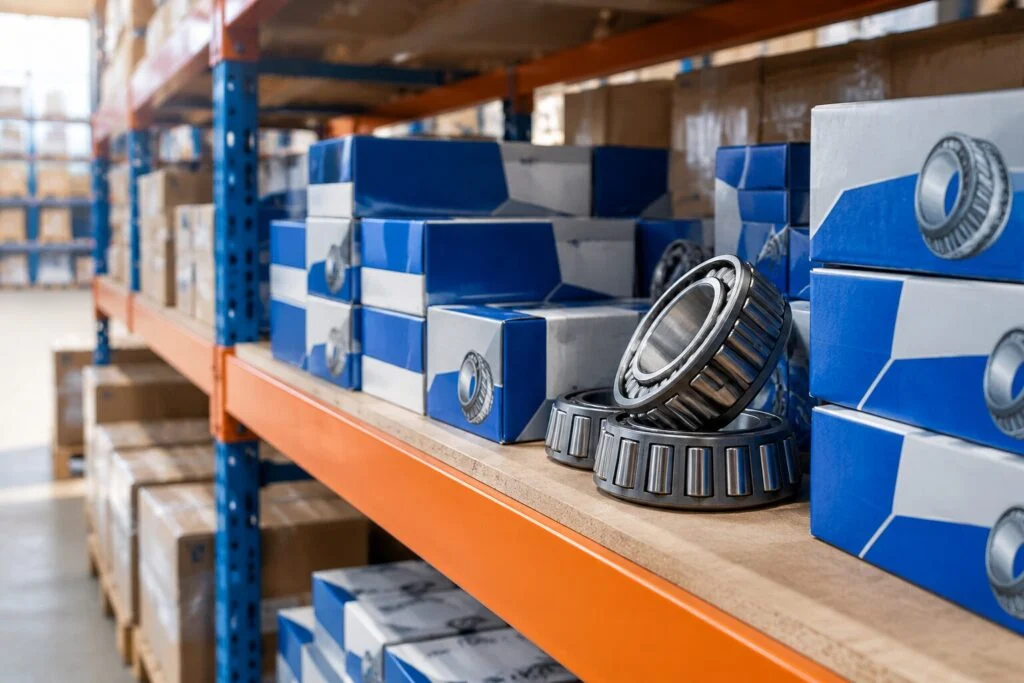
Stock Planning by Vehicle Population: Wholesale Bearing Supplier
Stocking every SKU is not safety; it is a capital trap.
Aligning your automotive bearing inventory with local vehicle population data prevents stockouts of fast-moving parts and minimizes dead stock of slow-moving models. This approach shifts procurement from guesswork to data-driven precision, ensuring that working capital is tied up in high-turnover items rather than gathering dust on shelves.
I still remember the humidity in a Jakarta workshop years ago. The owner pointed at a corner piled high with obscure bearing boxes while shouting about missing Toyota hub bearings for a fleet of taxis waiting outside. That mismatch was not bad luck; it was a failure to read the local vehicle parc. In Southeast Asia, where Japanese cars dominate the roads, the ratio of deep-groove ball bearings to tapered roller bearings differs significantly from markets dominated by European or American vehicles. Ignoring this demographic reality leads to the exact scenario I witnessed: critical shortages of high-demand items alongside an overstock of irrelevant SKUs. Effective Stock planning by vehicle population requires mapping inventory directly to the cars actually driving on local streets, not just following global brand catalogs blindly. [NEED_CITE: correlation between vehicle brand market share and bearing type demand]
Transitioning from intuitive ordering to analytical stocking transforms how wholesalers manage risk and liquidity.
Why Does Vehicle Population Dictate Bearing Stock?
Local car parc directly determines the demand ratio of deep-groove versus tapered roller bearings.
Different vehicle manufacturers engineer their wheel hubs and transmissions with specific bearing architectures. A region with a high concentration of older American trucks will have a vastly different consumption profile for tapered roller bearings compared to a city filled with modern compact Asian sedans that primarily use sealed deep-groove units. Understanding this mechanical distinction is the foundation of smart procurement.
In many emerging markets, the vehicle age profile skews older. As vehicles age, wear on wheel hubs increases, driving up the replacement frequency for specific bearing types. For instance, vehicles over five years old often require more frequent maintenance of tapered roller bearings due to their serviceable design, whereas newer models with sealed units may only see replacements after significant mileage or accident damage. [NEED_CITE: automotive aftermarket maintenance cycles by vehicle age]
Consider a distributor in Thailand who initially stocked bearings based on global bestsellers. He found himself overflowing with angular contact bearings suitable for high-performance European cars, which represented a tiny fraction of the local taxi and pickup truck fleet. Meanwhile, he constantly ran out of the basic deep-groove bearings needed for the ubiquitous Toyota Hilux and Isuzu D-Max. By analyzing national vehicle registration databases, he realized that over sixty percent of the local parc consisted of just three Japanese brands. Adjusting his Stock planning by vehicle population to reflect this dominance allowed him to reallocate budget from low-turnover European SKUs to high-volume Asian equivalents. This shift did not just clear space; it accelerated cash flow by ensuring that every dollar spent on inventory had a corresponding buyer in the market.
The key is not to stock everything, but to stock what moves.
How to Calculate the Right Stock Ratio?
Map the top five local car brands to specific bearing types and set safety stock levels accordingly.
Calculating the right mix involves more than counting cars; it requires translating vehicle models into part numbers. Start by identifying the top five vehicle brands in your target region. Then, cross-reference their most common models with the bearing types used in their wheel hubs, transmissions, and alternators. This creates a weighted demand matrix.
For example, if Brand A holds thirty percent of the market and its primary model uses a specific size of tapered roller bearing for the rear axle, that SKU becomes a tier-one priority. Conversely, if Brand B holds five percent of the market and uses a rare needle bearing, that item falls into a lower priority tier with minimal safety stock. [NEED_CITE: methodology for SKU prioritization based on market share]
| Vehicle Brand Share | Primary Bearing Type | Stock Priority | Safety Stock Level |
|---|---|---|---|
| High (Top 3 Brands) | Deep-Groove / Tapered Roller | Critical | High |
| Medium (Next 5 Brands) | Angular Contact / Cylindrical | Standard | Moderate |
| Low (Niche Brands) | Needle / Thrust / Special | Minimal | Low |
A buyer in Nigeria applied this method by segmenting his inventory into "fast-movers" and "slow-movers." He discovered that while Land Cruisers were prestigious, the sheer volume of older Corollas drove the actual bearing turnover. He adjusted his orders to ensure he never stocked out of the Corolla-specific hub units, even if it meant reducing the variety of luxury car bearings. This targeted approach to Stock planning by vehicle population reduced his average order fulfillment time because the most requested items were always on hand. It also simplified warehouse management, as staff could focus on rotating the high-priority stock efficiently.
Precision in mapping leads to efficiency in storage.
What to Do with Slow-Moving SKUs?
Shift from local stocking to flexible mixed-container consolidation for rare models.
Holding inventory for niche vehicles ties up massive working capital with little return. The counter-intuitive truth is that trying to be a one-stop shop for every possible bearing model often results in being out of stock for the ones that matter. For slow-moving SKUs, the strategy should not be elimination, but optimization through consolidation.
Instead of keeping large quantities of rare bearings in local warehouses, wholesalers can adopt a just-in-time approach using mixed-brand container consolidation. This allows buyers to order small quantities of various rare SKUs alongside their regular bulk orders of fast-movers. By combining these items into a single shipment, the logistics cost per unit drops significantly, making it economically viable to stock low-volume items without the burden of high holding costs. [NEED_CITE: logistics cost benefits of mixed-SKU container consolidation]
I worked with a supplier in Vietnam who struggled with dead stock from European luxury cars. He switched to a model where he kept only sample quantities locally and fulfilled larger requests through consolidated shipments from China. This flexibility meant he could offer a full catalog to his customers without the financial risk of pre-buying thousands of dollars worth of rarely sold parts. His customers appreciated the availability, and he appreciated the improved cash flow. This aspect of Stock planning by vehicle population acknowledges that not all demand needs to be met from local shelf stock. Some demand is better met through agile supply chain partnerships that allow for economical small-batch sourcing.
Flexibility beats volume for niche items.
How to Avoid Stockouts During Peak Seasons?
Use historical turnover data and vehicle aging trends to pre-stock high-wear hub bearings.
Seasonal spikes in repair work, often driven by weather conditions or holiday travel, can catch unprepared wholesalers off guard. However, these peaks are predictable if you analyze historical turnover data alongside vehicle aging trends. As a fleet of vehicles ages, the frequency of major repairs, including bearing replacements, increases. Combining this with seasonal factors allows for proactive stocking.
For instance, in regions with heavy rainy seasons, water ingress into wheel hubs accelerates bearing failure. Knowing this, a smart wholesaler will increase safety stock for wheel hub bearings in the months leading up to the rainy season. Similarly, before long holiday periods when road travel increases, pre-stocking common transmission and alternator bearings can prevent lost sales during peak demand. [NEED_CITE: impact of seasonal weather on automotive bearing failure rates]
A distributor in Indonesia noticed a consistent spike in demand for front wheel bearings every year before the major holiday exodus. By reviewing his sales data from previous years, he identified the specific SKUs that surged. He placed larger orders two months in advance, securing better pricing and ensuring availability. When the rush hit, his competitors were scrambling for air freight, while he was selling from his well-stocked warehouse. This proactive stance is a critical component of Stock planning by vehicle population, as it accounts for both the static makeup of the car parc and the dynamic factors that influence wear and tear. It turns reactive panic into planned profit.
Preparation turns seasonal pressure into opportunity.
Conclusion
Data drives availability; availability drives trust.
Effective Stock planning by vehicle population transforms inventory from a cost center into a strategic asset. By aligning stock with local vehicle demographics, optimizing slow-moving items through consolidation, and anticipating seasonal demand, wholesalers can reduce dead stock and ensure critical parts are always available. This disciplined approach builds long-term reliability with repair shops and end-users, proving that smart stocking is the backbone of a resilient automotive supply business.