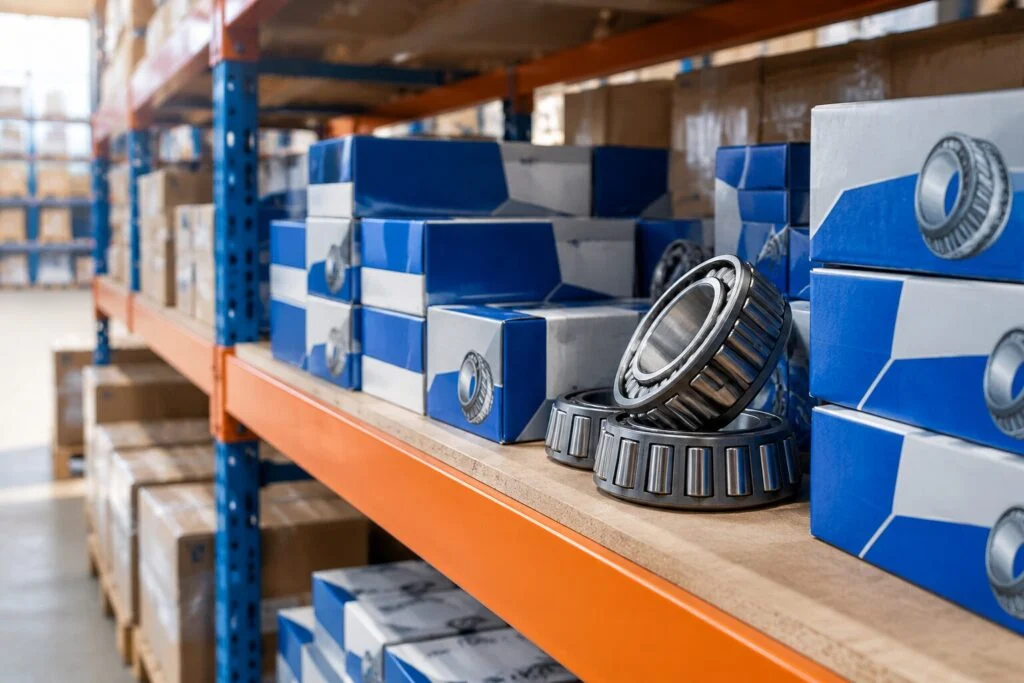
Supersession & Updated Bearing Numbers: Cross-Reference Supplier
Identical outer dimensions do not guarantee identical performance.
When a manufacturer updates a bearing part number, it is rarely a simple administrative change. The new designation often reflects critical internal modifications to cage design, heat treatment, or radial clearance that are invisible to the naked eye but vital for operational integrity. To handle bearing supersessions safely, procurement teams must move beyond basic dimensional matching and execute a rigorous cross-reference verification process that validates internal specifications against the original equipment manufacturer’s technical requirements. This approach prevents premature failure caused by subtle incompatibilities in load ratings or lubrication pathways.
I still recall the stifling heat of a compressor station in the Saudi desert, where the air shimmered off the metal casings of idle machinery. The project was stalled, not because of a lack of parts, but because of an abundance of wrong ones. A local supplier had rushed a replacement for an obsolete bearing number, assuring us that the outer diameter and bore matched perfectly. They were right about the size, but they were wrong about everything else. The substitute had a standard internal clearance, while the original design required a specific C3 clearance to accommodate thermal expansion under heavy load. Within hours of startup, the bearing seized. The resulting downtime cost far more than the price difference between a generic substitute and a verified genuine unit. That incident reshaped my understanding of supply chain reliability. It taught me that a part number is not just a label; it is a compact code for a complex set of engineering parameters. When those numbers change, the underlying physics often change with them. [NEED_CITE: impact of incorrect internal clearance on bearing thermal stability]
Why Do Bearing Part Numbers Keep Changing?
Manufacturers do not update part numbers for the sake of bureaucracy. These changes, known as supersessions, typically occur when a brand improves material purity, optimizes cage geometry for higher speeds, or adjusts sealing technologies to meet new environmental standards. For buyers holding outdated drawings, this creates a significant challenge. The old number may no longer appear in current catalogs, leading to the false assumption that the component is obsolete or unavailable. In reality, it has likely been upgraded.
The risk lies in assuming a one-to-one replacement without verification. A superseded number might have multiple successors depending on the application context. For instance, a standard deep-groove ball bearing might be replaced by a version with enhanced corrosion resistance for marine environments, or a high-speed variant for spindle applications. Without consulting the manufacturer’s official supersession list, a buyer might select the wrong variant. [NEED_CITE: common reasons for bearing part number supersession by major manufacturers]
In my experience working with MRO managers across various industries, the most common error is treating the catalog as static. Brands like SKF, FAG, and NSK frequently refine their product lines. A bearing that was once standard may now be considered a specialized item, or vice versa. Understanding this dynamic is crucial for maintaining equipment uptime. It requires a proactive approach to monitoring technical bulletins rather than reactive scrambling when a machine fails. The goal is to identify the functional equivalent, not just the dimensional twin. This is where a knowledgeable bearing supersession and updated numbers partner becomes essential, bridging the gap between legacy documentation and current manufacturing realities.
How to Verify Cross-References Accurately?
Blindly trusting online cross-reference tools can be dangerous. Many automated databases match only the primary dimensions: bore, outside diameter, and width. They often ignore critical secondary specifications such as internal radial clearance, precision class, and cage material. To verify a cross-reference accurately, you must compare the full technical datasheet of the proposed replacement against the original specification.
Start by identifying the original bearing’s suffix codes. These codes define the internal clearance (e.g., C2, C3, C4), precision grade (P0, P6, P5), and seal type. A replacement bearing must match these suffixes exactly unless a technical justification exists for a change. For example, substituting a C3 clearance bearing with a standard CN clearance unit in a high-temperature environment will lead to pre-loading and early fatigue failure. [NEED_CITE: ISO standards for bearing internal clearance and precision classes]
| Specification | Legacy Part Requirement | Proposed Replacement | Verification Status |
|---|---|---|---|
| Bore Diameter | Matches Original | Matches Original | Pass |
| Outside Diameter | Matches Original | Matches Original | Pass |
| Internal Clearance | C3 (Radial) | CN (Standard) | Fail |
| Cage Material | Steel | Polyamide | Check Application |
| Precision Class | P6 | P0 | Fail |
This table illustrates a typical pitfall. While the physical dimensions align, the internal clearance and precision class do not. Such a mismatch is a ticking time bomb. In a recent case involving a mining crusher, a distributor provided a cross-reference that matched the size but ignored the heavy-duty cage design required for vibratory loads. The replacement bearing disintegrated within weeks. The correct approach involves a manual review of the technical data sheets, focusing on load ratings and limiting speeds. [NEED_CITE: importance of cage design in high-vibration applications]
When navigating these complexities, relying on a bearing supersession and updated numbers expert ensures that every parameter is checked. They can confirm whether a newer material compound offers better performance or if a change in seal type affects lubrication intervals. This level of scrutiny transforms a risky guess into a calculated engineering decision.
What Risks Come with Blind Substitution?
The temptation to use a "close enough" substitute is strong when equipment is down and production targets are slipping. However, blind substitution carries severe risks that extend beyond immediate mechanical failure. The most insidious danger is misalignment. Bearings with different internal geometries may seat differently in the housing, causing slight angular misalignment. Over time, this induces uneven load distribution, leading to spalling and premature wear.
Another critical risk is lubrication incompatibility. Modern bearings often come pre-lubricated with specific greases designed for certain temperature ranges and speeds. A substitute bearing might use a different grease that reacts poorly with the existing system, causing hardening or leakage. In food processing or pharmaceutical applications, using a non-compliant seal material can lead to regulatory violations and product contamination. [NEED_CITE: effects of incompatible lubricants on bearing service life]
Consider the case of a European wind farm operator who replaced main shaft bearings using an unverified equivalent. The substitute had similar static load ratings but lower dynamic fatigue limits. Under the variable loads of wind turbulence, the bearings failed significantly earlier than expected, requiring costly crane rentals for replacement. The initial savings on the bearing cost were dwarfed by the logistics and downtime expenses. This scenario underscores why dimensional matching is insufficient. [NEED_CITE: case studies of bearing failure due to incorrect dynamic load rating selection]
To mitigate these risks, always demand traceability documentation. Genuine bearings come with batch numbers that link back to manufacturing records. This allows for verification of material certifications and quality control checks. A reliable bearing supersession and updated numbers service will provide this transparency, ensuring that every unit meets the original equipment manufacturer’s standards. Blind substitution is a gamble with high stakes; verified replacement is an insurance policy for your operations.
How to Source Genuine Replacements Globally?
Sourcing genuine replacements for obsolete or superseded bearings requires a partner with global reach and technical depth. Local distributors may lack access to updated cross-reference databases or the inventory depth to handle urgent requests. A global supplier, however, can tap into a network of warehouses and manufacturer relationships to locate the correct part quickly.
The key is to find a supplier who offers more than just transactional sales. Look for providers who offer technical selection support and cross-brand equivalent consultation. They should be able to interpret your old drawings, identify the current superseded number, and validate the technical compatibility of the replacement. This service is invaluable for MRO teams managing mixed fleets of equipment from different eras and manufacturers. [NEED_CITE: benefits of centralized technical support in global bearing procurement]
Inventory availability is another critical factor. A supplier with massive spot inventory can reduce lead times from weeks to days. This is particularly important for emergency spare parts where downtime costs are exponential. Additionally, ensure the supplier provides complete traceability documentation, including certificates of origin and conformity. This protects your business from counterfeit risks and ensures compliance with industry regulations.
When evaluating potential partners, ask about their process for handling bearing supersession and updated numbers. Do they rely solely on automated tools, or do they have engineers who review complex cases? Can they provide samples for testing before bulk orders? These questions reveal the depth of their expertise. A true partner acts as an extension of your engineering team, helping you navigate the complexities of modern bearing technology. By prioritizing technical validation over simple price comparison, you secure the longevity and reliability of your critical assets.
Conclusion
Verification is cheaper than failure.
Handling bearing supersessions demands a shift from reactive purchasing to proactive technical validation. By focusing on internal specifications rather than just external dimensions, you protect your equipment from hidden incompatibilities. Partnering with a supplier who understands the nuances of bearing supersession and updated numbers ensures that every replacement is a genuine upgrade, not a compromised substitute. This disciplined approach minimizes downtime and maximizes the return on your maintenance investments.