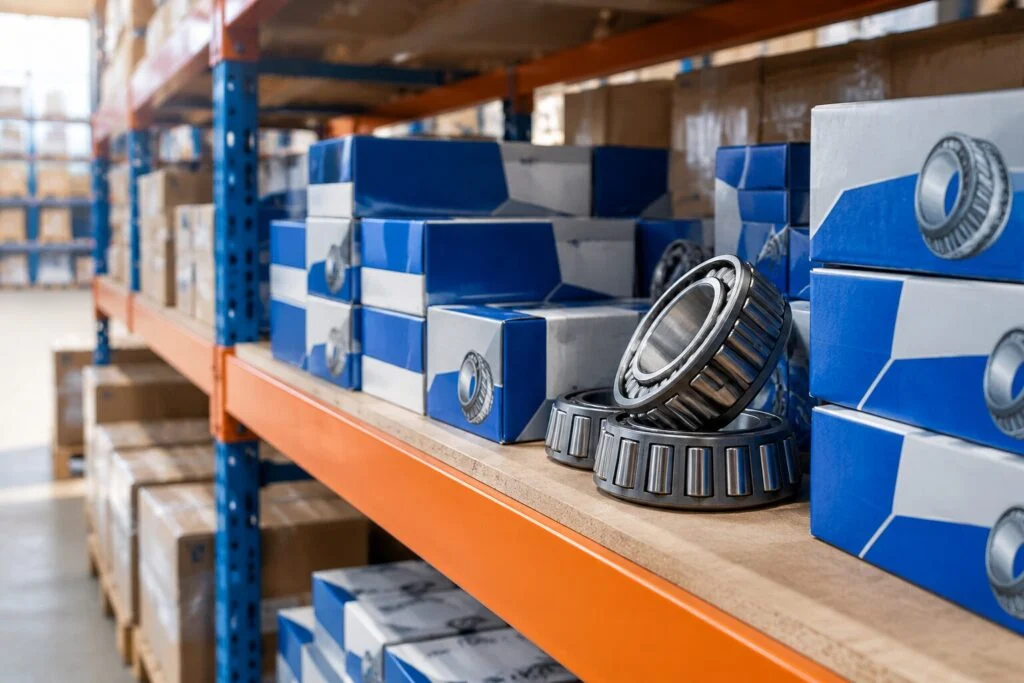
Wheel Bearing Play Check on a Lift: Wholesale Supplier
Tighter is not better. In fact, excessive preload is the primary cause of premature roller crushing in lift applications.
To correctly perform a wheel bearing play check on a lift, you must measure axial and radial clearance using a dial indicator while the wheel is suspended, ensuring the reading falls within the manufacturer’s specified tolerance range rather than forcing a zero-play condition. This process prevents the catastrophic internal damage caused by over-tightening tapered roller bearings.
I still remember the humidity in that Southeast Asian logistics hub. The air was thick, but the tension in the maintenance manager’s office was heavier. He had a stack of seized forklift wheels on his desk, each one showing signs of extreme heat discoloration. He was convinced we had sent him defective stock. The bearings were from a top-tier global brand, yet they had failed within months. I picked up a damaged unit and rotated the inner ring. It didn’t spin; it grated. The rollers were flattened, not worn. This was not a material failure. It was an assembly error. The local team had tightened the locknuts until there was absolutely no movement, believing that zero play meant maximum stability. They had ignored the fundamental requirement of a wheel bearing play check on a lift. That trip changed how I approach technical support. Now, I see that most premature failures are not about the quality of the steel, but the precision of the installation. [NEED_CITE: common causes of tapered roller bearing failure per ISO 15243]
Understanding why this measurement matters is the first step toward reducing unplanned downtime in your facility.
Why is checking wheel bearing play crucial for lifts?
Proper clearance prevents roller crushing and extends lifespan.
Lifts and heavy-duty material handling equipment operate under dynamic loads that differ significantly from static machinery. When a forklift or warehouse lift carries a load, the weight transfers through the mast and onto the wheels. If the bearings are adjusted with excessive preload, the rolling elements are forced against the raceways with too much pressure even before any external load is applied. This creates intense friction and heat.
In a cold storage environment, this issue becomes even more critical. I once consulted with a facility in Northern Europe where their electric pallet lifts were generating unusual noise and overheating after just a few weeks of operation. The maintenance team had tightened the bearings to eliminate any perceived wobble. However, as the bearings heated up during operation, the metal expanded. Because there was no initial clearance, this thermal expansion had nowhere to go. The result was immediate seizure. After we guided them through a proper wheel bearing play check on a lift, adjusting the preload to allow for thermal expansion, the operating temperature dropped noticeably, and the noise vanished. [NEED_CITE: effects of thermal expansion on bearing preload]
The core argument here is simple: bearings need room to breathe. Tapered roller bearings, which are common in lift applications due to their ability to handle combined radial and axial loads, require a specific amount of end-play. Without it, the lubricant film breaks down, leading to metal-to-metal contact. This is not a defect in the bearing; it is a defect in the method. By prioritizing a precise wheel bearing play check on a lift, you ensure that the bearing operates within its designed stress limits, significantly extending service life.
What tools are required for an accurate play check?
Dial indicators and feeler gauges ensure precise measurement.
You cannot judge bearing play by hand. The human sense of touch is not sensitive enough to detect the micron-level clearances required for modern industrial bearings. Relying on "feel" leads to inconsistency and, often, over-tightening. To perform a reliable wheel bearing play check on a lift, you need specific instrumentation.
The primary tool is a magnetic base dial indicator. This device allows you to measure axial displacement with high precision. You attach the magnetic base to a stationary part of the axle or hub, and the plunger of the indicator rests against the rotating hub or wheel flange. When you push and pull the wheel, the dial shows the exact amount of movement. For many standard lift applications, a resolution of 0.01 mm is sufficient, but for high-precision equipment, you may need finer resolution. [NEED_CITE: standard tools for bearing installation and maintenance]
Additionally, a set of feeler gauges can be useful for initial rough checks or for verifying shim thickness if your lift design uses shims instead of adjustable locknuts. However, the dial indicator remains the gold standard for final verification. Some technicians also use a torque wrench to measure the rotational drag, but this method is less direct and can be influenced by seal friction or lubricant viscosity. Therefore, combining a dial indicator for axial play measurement with a visual inspection of the bearing components provides the most comprehensive data.
Having the right tools is only half the battle. Knowing how to use them in the context of a wheel bearing play check on a lift ensures that your measurements are repeatable and accurate. Without these tools, you are essentially guessing, and in heavy industry, guesses lead to failures.
How to perform the step-by-step wheel bearing play check?
Lift the wheel, measure axial/radial play, and compare with tolerances.
Performing a wheel bearing play check on a lift requires a systematic approach. Rushing this process is the most common mistake made by field technicians. Here is the method I recommend based on years of observing installations across various industries.
First, ensure the lift is securely supported and the wheel is free to rotate. Remove any dust caps or locking wire that might obstruct access to the adjustment nut. Clean the area around the nut to prevent contamination from entering the bearing assembly during the check.
Second, mount the dial indicator. Position the magnetic base on a solid, non-rotating part of the axle housing. Place the tip of the indicator against the face of the hub or the wheel rim, ensuring it is perpendicular to the axis of rotation. Zero the dial.
Third, apply axial force. Push the wheel inward firmly, then pull it outward. Observe the total movement on the dial indicator. This reading represents the axial play. Do not rotate the wheel while measuring axial play, as this can introduce radial errors. For radial play, you can position the indicator against the outer diameter of the hub and move the wheel up and down, though axial play is the primary metric for tapered roller bearing adjustment. [NEED_CITE: procedure for measuring bearing clearance]
Fourth, compare the reading with the OEM specifications. Most manufacturers provide a specific range for acceptable play, often between 0.05 mm and 0.15 mm, depending on the bearing size and application. If the play is outside this range, adjustment is necessary. If it is within range, the bearing is correctly set.
This step-by-step process removes subjectivity. Instead of relying on intuition, you have a numerical value that confirms the state of the bearing. This is the essence of a professional wheel bearing play check on a lift. It transforms maintenance from a reactive task into a predictive, data-driven practice.
How to adjust the preload correctly after checking?
Fine-tune the locknut to achieve optimal clearance without over-tightening.
If your wheel bearing play check on a lift reveals that the clearance is incorrect, you must adjust the preload. This is a delicate operation. The goal is to eliminate excessive looseness without introducing harmful tightness.
Start by loosening the locknut slightly if the play is too small, or tightening it if the play is too large. For tapered roller bearings, the standard procedure involves tightening the nut while rotating the wheel to seat the rollers properly. Then, back off the nut by a specific angle or amount as recommended by the bearing manufacturer. This backing-off step is crucial because it creates the necessary internal clearance.
I recall a case with a heavy-duty warehouse lift where the rollers were crushing under high load. The analysis showed that the locknut had been torqued to a high value without the subsequent back-off. The bearings were effectively preloaded to death. After we adjusted the nuts to allow for the specified end-play, the load capacity utilization ratio improved, and the failures stopped. [NEED_CITE: tapered roller bearing adjustment techniques]
During this adjustment, it is vital to use genuine components. Substandard locknuts or washers can deform under torque, leading to gradual loosening and increased play over time. We supply genuine tapered roller bearings from brands like SKF, TIMKEN, and ZWZ, along with the associated hardware, to ensure that every component in the assembly meets the required standards. Our technical support team often assists clients with failure analysis, helping them distinguish between material defects and installation errors.
Once the adjustment is made, re-perform the wheel bearing play check on a lift to verify the new setting. Install the locking device, such as a cotter pin or lock washer, to secure the nut. Finally, rotate the wheel by hand to ensure it moves smoothly without binding or unusual noise.
Correct adjustment is not just about following steps; it is about understanding the mechanics of the bearing. By mastering this skill, you protect your equipment and ensure operational safety.
Conclusion
Precision prevents failure. A rigorous wheel bearing play check on a lift is the most effective way to avoid premature bearing damage and ensure smooth operation. By using the right tools, following a structured measurement process, and adjusting preload with care, you can extend the life of your equipment and reduce costly downtime. Remember, the goal is not zero play, but optimal play.