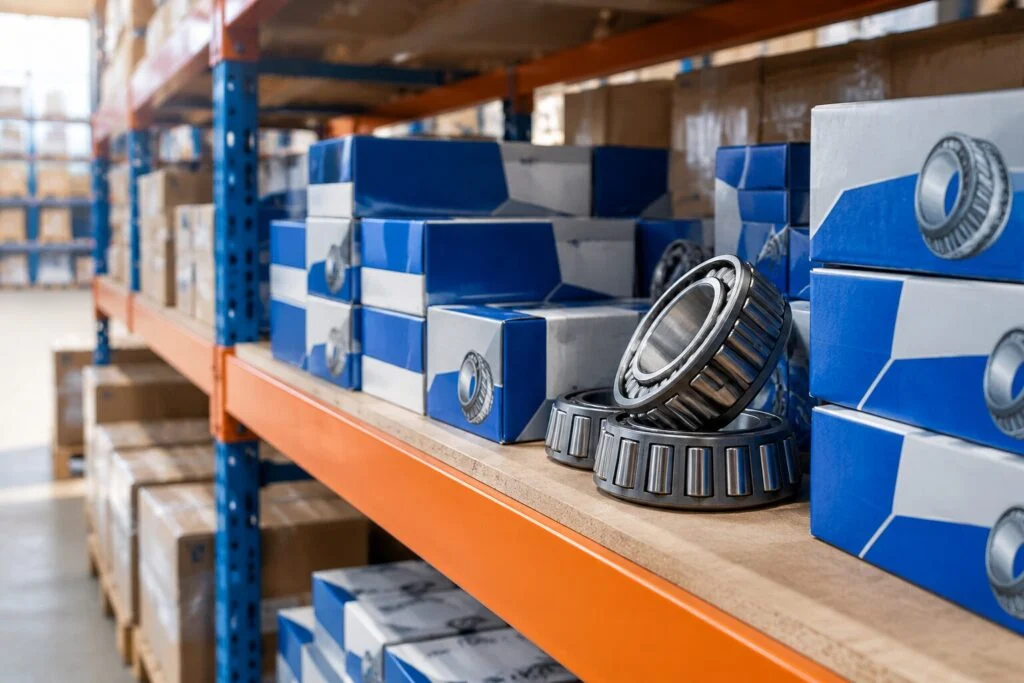
Wheel Bearings for Minibuses: Genuine Brands Wholesale Supplier
Most think bearing failure is just bad installation; truly, it is often inferior grease melting in tropical high-heat.
Selecting the right Wheel Bearings for Minibuses requires genuine tapered roller bearings with precise dimensional matching and full traceability to withstand high-frequency, high-temperature commercial operations. Avoiding catastrophic mid-route lockups depends on sourcing from suppliers who provide ISO-compliant documentation and mixed-brand consolidation capabilities, ensuring that fleet operators do not face exponential downtime losses due to counterfeit or substandard components.
I still remember the humidity clinging to the air at Tanjung Priok Port in Jakarta, watching a container of auto parts get held up for days. The owner, a local transport boss, had tried to cut costs by buying a batch of unbranded hub assemblies from a roadside supplier. His minibuses, running daily routes on rough tropical roads, started locking up after only a few thousand kilometers. The heat was so intense that the cheap grease inside had turned into a sludge, causing the rollers to seize. He lost more money in tow fees and passenger refunds than he ever saved on the initial purchase. That scene taught me that for commercial fleets, the integrity of Wheel Bearings for Minibuses is not just a maintenance detail; it is the backbone of operational profitability. [NEED_CITE: impact of bearing failure on commercial fleet uptime]
The difference between a smooth-running fleet and a logistical nightmare often comes down to what happens inside the wheel hub when temperatures soar.
Why Do Minibus Wheel Bearings Fail Prematurely?
High-frequency loads and extreme heat expose the material limits of inferior bearings.
Minibuses operate in a unique stress environment. Unlike private cars that sit idle for hours, these vehicles run nearly continuously, carrying heavy passenger loads over uneven surfaces. This creates a cycle of high radial and axial loads that standard passenger car bearings are not designed to handle. When you combine this mechanical stress with the ambient heat of regions like Southeast Asia or the Middle East, the internal temperature of the wheel hub can rise significantly. [NEED_CITE: thermal dynamics in commercial vehicle wheel ends]
The primary culprit in premature failure is rarely the steel itself, but the lubrication and the cage material. Cheap bearings often use low-grade grease with a low dropping point. As the hub heats up, this grease loses its viscosity, failing to form a protective film between the rollers and the raceways. Without this film, metal-to-metal contact occurs, leading to rapid wear, scoring, and eventually, seizure. I have seen hubs where the rollers had welded themselves to the cage due to such extreme thermal breakdown.
Another common issue is the use of inferior cage materials. In high-speed or high-vibration applications, a weak cage can deform, causing the rollers to bunch up on one side. This uneven load distribution accelerates fatigue spalling on the raceway. For distributors and fleet managers, understanding that Wheel Bearings for Minibuses must be specified with high-temperature stable grease and robust cage designs is critical. It is not enough to just match the part number; the internal construction must match the operational reality.
Failure analysis reports often point to "installation error" as the cause, but a deeper look usually reveals material inadequacy. [NEED_CITE: root cause distribution per ISO 15243]
How to Select the Right Tapered Roller Bearings?
Precise dimensional matching and high-temperature grease specifications are non-negotiable.
When sourcing Wheel Bearings for Minibuses, the focus must shift from price to specification compliance. Tapered roller bearings are designed to handle combined loads, making them ideal for the front wheels of minibuses where steering forces add to the vertical load. However, their performance is highly sensitive to preload and alignment.
Selecting the correct bearing involves more than just checking the outer diameter and bore. You must verify the internal clearance class. For commercial vehicles operating in hot climates, a C3 or C4 internal clearance is often recommended to allow for thermal expansion of the inner ring and rollers. If the clearance is too tight, the bearing will overheat and fail prematurely. If it is too loose, it will cause vibration and noise. [NEED_CITE: ISO standards for internal clearance in rolling bearings]
Here is a comparison of what to look for when evaluating bearing quality:
| Feature | Premium Genuine Bearing | Low-Cost Aftermarket |
|---|---|---|
| Steel Quality | Vacuum-degassed, high-purity steel | Standard carbon steel with higher inclusion count |
| Heat Treatment | Controlled carburizing for surface hardness | Inconsistent hardening, prone to soft spots |
| Grease Type | High-temperature, lithium-complex base | Basic mineral oil grease, low dropping point |
| Cage Material | Pressed steel or polymer, reinforced | Thin, unhardened steel, prone to deformation |
| Surface Finish | Micron-level precision, super-finished raceways | Visible tool marks, higher friction coefficient |
The table above highlights why genuine brands like SKF, NSK, or Timken maintain a reputation for reliability. Their manufacturing processes ensure that every batch meets strict tolerance levels. For a buyer, this consistency means that when you install a bearing, it performs exactly as the engineering data predicts. There are no surprises.
I once helped a distributor in Africa who was struggling with warranty claims. We switched his supply chain to genuine Wheel Bearings for Minibuses from established brands. The change was not immediate in terms of sales volume, but the return rate dropped noticeably. His customers, mostly fleet owners, realized that the vehicles stayed on the road longer. The technical selection support we provided helped them identify the exact C3 clearance variants needed for their specific bus models, eliminating the guesswork.
What Are the Hidden Costs of Non-Genuine Bearings?
Mid-route lockups and customs rejections destroy profit margins.
The sticker price of a bearing is only a fraction of its total cost of ownership. For commercial operators, the real cost lies in downtime. A minibus that breaks down in the middle of a route does not just need a new bearing; it needs a tow truck, a mechanic, and potentially compensation for stranded passengers. This cascade of expenses can easily exceed the cost of a premium bearing by several times. [NEED_CITE: economic impact of unplanned vehicle downtime in public transport]
Furthermore, for distributors and importers, there is the risk of customs rejection. Many countries have tightened regulations on auto parts to combat counterfeiting. Importing bearings without proper traceability documentation can lead to shipments being seized or destroyed. I have witnessed containers full of fake bearings being confiscated at ports because the paperwork did not match the physical goods. The financial loss from such an event is devastating, not to mention the damage to the importer’s reputation.
Genuine bearings come with full traceability. Each box has a unique code that can be traced back to the factory production batch. This documentation is essential for clearing customs and for providing proof of authenticity to end-users. When you source Wheel Bearings for Minibuses from a reputable supplier, you are also buying this peace of mind. The ability to prove that your products are genuine protects your business from liability and builds trust with your customers.
A European repair group once shared how they reduced their overall maintenance costs by switching to genuine parts. Although the upfront cost was higher, the reduction in repeat repairs and warranty claims resulted in net savings. Their technicians spent less time diagnosing recurring issues and more time on productive work. This efficiency gain is a hidden benefit that often goes unnoticed until you make the switch.
How to Source Genuine Bearings Reliably?
Full traceability and flexible mixed-brand consolidation are key.
Finding a reliable source for Wheel Bearings for Minibuses requires looking beyond the lowest price. You need a partner who understands the complexities of global supply chains and the specific needs of the aftermarket. A professional supplier should offer genuine products from multiple mainstream brands, allowing you to consolidate orders and reduce shipping costs.
One of the biggest challenges for regional distributors is managing inventory for various vehicle models. Holding stock for every possible bearing size is capital-intensive. A good supplier offers flexible MOQs, allowing you to order mixed batches of SKF, NSK, FAG, and other brands in a single container. This flexibility helps you maintain a diverse inventory without tying up excessive cash flow. It also ensures that you can meet urgent requests from different customers without waiting for separate shipments.
Technical support is another critical factor. A supplier who can provide cross-brand equivalent model lookup services saves you time and reduces errors. Instead of manually searching through dozens of catalogs, you can rely on their expertise to find the right replacement. This service is particularly valuable when dealing with older minibus models where original part numbers may be obsolete or hard to find.
When evaluating a supplier, ask for their traceability documentation process. Can they provide mill certificates or origin proofs? Do they have a system for verifying the authenticity of each batch? These questions will help you distinguish between a true partner and a mere trader. The goal is to build a supply chain that is resilient, transparent, and capable of supporting your growth.
Sourcing is not just about buying products; it is about securing a reliable flow of quality components that keep your customers’ businesses running. [NEED_CITE: best practices for automotive aftermarket supply chain management]
Conclusion
Genuine bearings prevent catastrophic failures and protect your bottom line.
Choosing the right Wheel Bearings for Minibuses is a strategic decision that impacts safety, reliability, and profitability. By prioritizing genuine tapered roller bearings with proper traceability and high-temperature specifications, you avoid the hidden costs of downtime and customs issues. Partnering with a supplier who offers mixed-brand consolidation and technical support ensures that your supply chain remains efficient and resilient. In the demanding world of commercial transport, quality is not an expense; it is an investment in continuity.